The Square-Foot Rule: A Three-Minute Kitchen Reset That Makes Dinner Feel Possible
It's 6:12 on a Tuesday. You open the fridge, look at the chicken, look at the counter, and close the fridge again. There's a stack of mail on the cutting board, a mug from this morning, a container of something that used to be rice, and a grocery bag you never fully unpacked. Dinner isn't the hard part, exactly. Dinner is just sitting behind all of that.
Here's the thing worth knowing before you beat yourself up about it: you don't need a clean kitchen to cook. You need about one square foot of it.
Why a small pile of stuff drains a surprisingly large amount of attention
Psychologists who study focus talk about attention residue — the mental smudge that lingers after you bounce from one task to another. Clutter does something similar. Every object on your counter is a tiny unfinished conversation, and your brain, that cheerful overachiever, keeps a running tab open: deal with me, deal with me, deal with me.
None of those items are emergencies. That's exactly the problem. Low-grade, low-stakes decisions are the ones that quietly wear you down, because you have to make them a hundred times before you make any of them once. By the time you've walked past the same pile of mail four times, deciding what to cook starts to feel like the tenth item on a list you never wrote.
So the goal here isn't a spotless kitchen. It's fewer open tabs.
The three-minute reset, step by step
1. Start the timer before you start tidying. Three minutes. Phone timer, microwave timer, whatever's closest. The timer isn't there to pressure you — it's there so your brain knows this has an end, which makes it much easier to begin.
2. Choose your square foot on purpose. Not the worst corner of the counter. The corner you'll actually work in — beside the cutting board, next to the sink, wherever the knife lands. You're clearing a workspace, not a war zone.
3. Give every item one of three destinations. Trash and recycling. The sink — not washed, just in the sink, which is not the same thing and doesn't need to be. Or the "not now" bin, which we'll get to in a second.
4. Wipe it once. One pass with a damp cloth. Not a scrub, not a sanitizing ritual. A single swipe so the surface reads as ready instead of used.
5. Stop at three minutes. Even mid-pile. Especially mid-pile. The reset is not a cleaning project wearing a disguise — it's a signal, and signals work best when they're short enough to repeat.
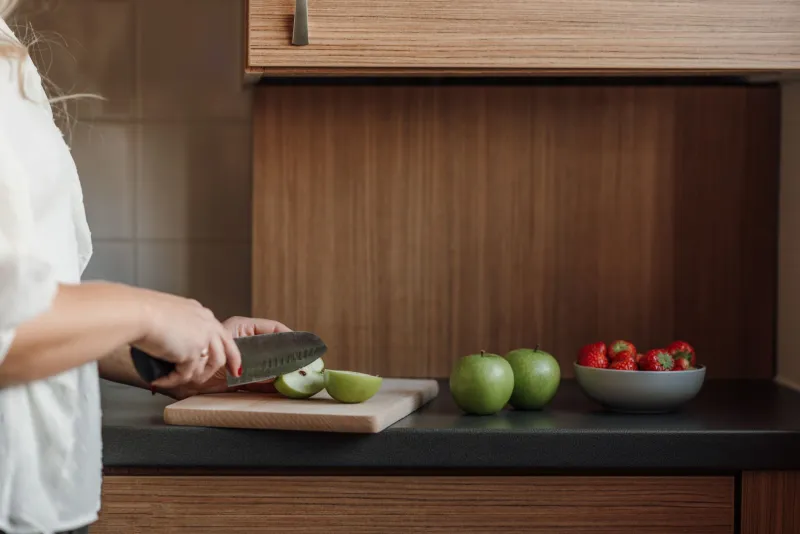
Then make the ending visible. Set out the cutting board. Put the knife on it. Turn on the light over the stove. Give your eyes one clear piece of evidence that says: we're doing this now.
The "not now" bin is doing most of the work
Here's the part people skip. You need somewhere innocent to put the things that belong nowhere on a counter but also don't deserve a decision at 6:12 p.m.
One bin. No lid. Anything that isn't trash and isn't yours-to-wash-right-now goes in it. Sunday, or whenever you feel like it, you sort the bin. Or you don't, and it becomes a slightly fuller bin. Nobody is grading this. The bin exists so your counter doesn't have to hold everything you're postponing.
If your kitchen is the size of a hallway closet
Same rule, smaller real estate. In a studio or a galley kitchen, your square foot might be the strip of counter between the sink and the stove, or a cutting board laid across the burners. Vertical stacks and a single hanging hook do a lot of quiet labor. So does accepting that a small kitchen's reset looks like two items moved and a wipe rather than a magazine spread.
If you share the kitchen
This is where the square-foot rule becomes something better than a cleaning tip: it becomes a boundary. You are not the household's janitor, and a three-minute reset should not turn into a forty-minute resentment tour of everybody else's dishes.
So name your patch out loud. Something like: "I'm clearing my little corner so I can cook — anything of yours is going on the tray by the toaster." Cheerful, factual, zero accusation. Kids can be handed the tray and told it's theirs to empty before screens. A partner who leaves coffee cups everywhere isn't a moral emergency; they're just a person whose cup now lives in a different spot.
For low-energy nights, shrink it further
The two-object version: put two things away and stop. Or clear the square foot where the coffee maker sits, so that tomorrow morning's first thirty seconds are kind to you. Or decide, without guilt, that tonight is frozen dumplings and a clean six inches to eat them over. The reset is meant to lower the bar for dinner, never to become a hurdle you have to clear before you're allowed to eat.
What one square foot actually buys you
Not a showroom kitchen. A decision that's already made. When the surface is clear and the board is out, cooking stops being a negotiation and starts being the next obvious thing. And there's a small, underrated satisfaction in standing at a clean patch of counter in an otherwise imperfect kitchen — the reminder that order doesn't require a whole afternoon, just a place to start.
Tomorrow the pile will come back. It always does. But you'll know the move, and it will take three minutes, and dinner will be waiting on the other side of it.