Gratitude Without the Grind: Seven Tiny Thanksgiving Week Rituals That Fit Real Life
Thanksgiving week has a way of arriving like a group text you forgot to mute. There is travel, or the avoidance of travel. There is a kitchen that suddenly needs three more hands. There is family, which is another word for people who know exactly how to find your last nerve. And somewhere in the middle of all that, someone suggests a gratitude challenge, and you think: great, one more thing to do.
This is not that kind of challenge. The point of the next seven habits is not to perform thankfulness for an audience or to pretend the holiday is a Hallmark card. It is to sneak in small moments of noticing that make the week feel a little less like a sprint. Each one takes five minutes or less. None requires a journal you love, a matching pen, or a family that cooperates on cue. Pick two or three. That is enough.
1. Try a pre-meal good-thing round
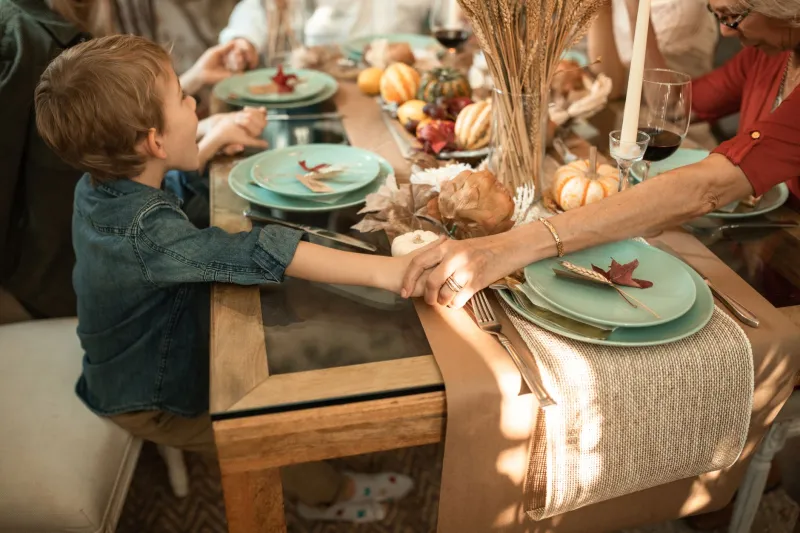
Before the plates get passed, go around the table and ask each person for one good thing from the past year. Keep it to one sentence. No speeches, no rebuttals, no fixing anyone's answer. If your cousin says the best part of the year was a new video game, that counts. If someone says they are just glad to be here, that counts too. The round is not a test of depth. It is a tiny pause that reminds everyone there is more to the year than the current argument about stuffing.
If your family is more of a talk-over-each-other crowd, try a written version. Put a few index cards and a pen near the plates and let people scribble one good thing as they sit down. You can read them aloud later, or not. The card is not homework. It is a landing pad for a thought.
2. Take a gratitude walk, even a short one
A gratitude walk sounds like something a wellness influencer would do in linen pants, but it can be extremely ordinary. Walk to the end of the block. Walk around the parking lot of the hotel. Walk to the car and back because you forgot the cranberry sauce. While you walk, name three things you can see, hear, or feel that you are glad exist. A dry sidewalk. A text from a friend. The fact that gas stations sell coffee at 6 a.m.
Five minutes is plenty. The walk works because it changes your scenery and gives your brain a small job. If the holiday is chaotic, it is also an excuse to leave the house for a minute without making a thing of it. Take the trash out slowly. Volunteer for the ice run. Gratitude does not have to be a ceremony. Sometimes it is just a lap around the block.
3. Text one person who helped you this year
Think of someone who made 2026 a little easier. Maybe they covered a shift, listened to you vent and did not offer unsolicited advice, or sent a meme at exactly the right moment. Send them a short text. Be specific. Say what they did and why it mattered. You do not need to write a speech or wait for a reply.
This is a good one to do while waiting for a flight, standing in line at the grocery store, or hiding in the bathroom at a relative's house. It takes two minutes, and it gives you a small hit of connection when holiday togetherness is feeling more like holiday togetherness. The person on the other end gets proof they mattered. You get a reminder that help is not abstract. It has a phone number.
4. Thank the people who make the day run
Thanksgiving has a lot of invisible labor. Someone brined the turkey. Someone remembered the napkins. Someone is doing dishes while everyone else debates the parade. Pick one person and thank them for a specific task. Not just thanks for having us. Try thanks for handling the oven timing, or thanks for making sure Grandma got a ride, or thanks for taking the trash out before it became a whole thing.
Specific thanks is a tiny act of respect. It also helps you notice the machinery of the day instead of only the menu. If you are hosting, thank yourself too. You do not have to say it out loud. A quiet mental high-five while you scrub a pot counts.
5. Do a hard thing, good thing note
Optimism is not the same as ignoring what is hard. Gratitude that skips over stress can feel fake, and fake gratitude is exhausting. So try this: write down one hard thing about the week and one good thing pretty close to it. Keep both real. The hard thing might be that travel is expensive, that a family relationship is strained, or that you are missing someone. The good thing might be that you have a place to go, or a friend who checks in, or a really excellent piece of pie.
The note can be private. It can be messy. It can live in your phone's notes app next to a grocery list. The goal is not to solve the hard thing. It is to hold two truths at once, which is a skill that comes in handy long after the leftovers are gone.
6. Make a sticky-note landing strip
Put a small stack of sticky notes and a pen on the fridge, the entry table, or the laptop lid. Invite anyone who is around to add one thing they are glad about. No pressure. No craft supplies. No one has to make it cute. The notes can be profound or deeply unserious. Someone might write: my dog. Someone else might write: not hosting next year.
This is a low-stakes way to make gratitude visible without turning it into a family performance. It also gives kids, quiet cousins, and people who hate group shares a way to participate. At the end of the week, take a photo of the notes and recycle them. You do not have to keep the shrine. The point is the pause.
7. Keep a private end-of-day highlight
At the end of each night, before you scroll or collapse, name one thing you are glad you did not miss. It can be tiny: the first sip of coffee, a text from a friend, a five-minute conversation on the porch, the way the kitchen smelled before the crowd arrived. Do not worry about whether it is the best thing. It is just a thing.
This is especially useful if you are traveling alone, hosting with a lot on your plate, or feeling out of sync with the holiday. You are not grading the day. You are collecting evidence that good moments still happen alongside the mess. That is the whole challenge, really. Not thankful, not stuffed. Just a little more awake to the good stuff that was already there.