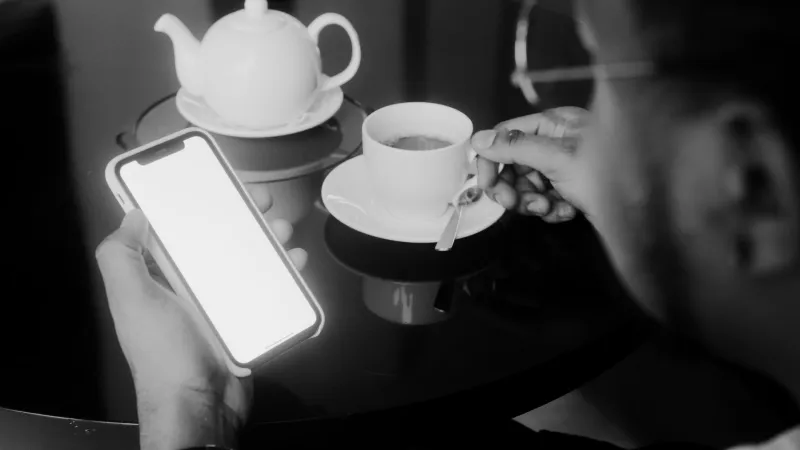
Leave the Phone, Take the Mug: A Tiny Afternoon Ritual for a Clearer Head

It is 2:47 on a Tuesday. Your coffee has gone lukewarm, your inbox has gone feral, and your phone is in your hand again. You are not really reading anything. You are just letting the afternoon scroll past your eyes.
Now imagine a different version of the same afternoon. You stand up, walk to the kitchen, and leave your phone on the counter. You make a cup of coffee or tea. Then you sit down for five minutes and do nothing but drink it.
No podcast. No quick check of Slack. No mental rehearsal of tomorrow's meeting. Just you, a mug, and a window.
It sounds almost too simple to count as self-care. But that is the point. Small, repeated moments of undivided attention are an underrated optimism practice. They do not fix a chaotic day. They do give your brain a tiny piece of evidence that the day is not only a to-do list.
Why five minutes is enough to matter
Big wellness plans tend to collapse under their own ambition. A five-minute break is different. It is short enough that you can do it on a bad day, a busy day, or a day when your best-laid plans have already fallen apart.
Habit science keeps returning to the same useful idea: make the behavior small, attach it to something that already happens, and repeat it often enough that it stops requiring a decision. A five-minute pause after lunch is easier to repeat than a hourlong reset you need to schedule, protect, and mentally prepare for.
There is also something quietly powerful about undivided attention. Most of us spend the day switching between inputs. A phone-free coffee break gives your attention one job: notice the warmth of the mug, the taste of the drink, the light coming through the window, the fact that you are sitting down. That is not a productivity hack. It is a small recovery period.
The rules are almost embarrassingly simple
Here is the whole ritual:
- Leave your phone in another room. Not face down on the table. Not in your pocket. Another room.
- Make a drink you actually like. Coffee, tea, cocoa, decaf, hot water with lemon. This is not a competition.
- Sit down for five minutes. A timer is fine if you need permission to stop.
- Do not add entertainment. No podcast, no laptop, no group chat. Looking out a window is allowed. Staring at a wall is allowed.
- Repeat at roughly the same time each day. After lunch works well for a lot of people. So does the late-afternoon dip.
That is it. You are not meditating correctly. You are not optimizing your afternoon. You are just taking a break that is actually a break.
What this has to do with optimism
Optimism is not the belief that everything is fine. It is the willingness to look for what is still good, workable, or worth tending. A phone-free coffee break is a small version of that. It interrupts the story that the day is one long emergency.
Five minutes will not erase a difficult project or a tense conversation. But it can shift your nervous system out of go-go-go mode for a moment. It can remind you that you are a person with senses, not just a inbox with legs. And when you repeat it, you start to build a small expectation that there will be a pause available to you again tomorrow.
That is a modest kind of hope. It is also the kind that lasts.
Try this one-week experiment
Pick one anchor point. Maybe it is after you finish lunch, after your last morning meeting, or before school pickup. Then choose a phone parking spot that is genuinely out of reach. A bedroom, a drawer, a hallway table. Somewhere you will not instinctively grab it.
For one week, make the drink, sit down, and notice one thing. At the end of the five minutes, jot down a single sentence: what the break felt like, what you noticed, or how your afternoon changed. Keep it to one sentence. This is not a journaling project.
If you want a little data, rate your afternoon energy from one to five before and after. You do not need a spreadsheet. You just need to pay enough attention to see whether the ritual is doing anything for you.
Make it stick when you are too busy
Busy is exactly when the ritual helps most, which is also exactly when it feels most impossible. So lower the bar until it is almost silly. Five minutes is the goal, but two minutes still counts. If you cannot leave the phone in another room, put it in a drawer across the room. If you cannot make coffee, pour a glass of water.
Stack the break onto something that already happens. After you clear your lunch dishes, you make a drink. After you send your last morning email, you sit down. Tell a coworker what you are doing so they know why you have disappeared for five minutes. Put a calendar hold called Coffee. Make it boring and predictable, and it will survive more days.
You can also make the ritual portable. At home, use the good mug. At the office, use the mug that does not remind you of a terrible meeting. When you travel, use a paper cup and a window. The container changes. The pause does not have to.
A note for coffee haters and fidgeters
You do not have to like coffee. Tea, decaf, broth, or ice water all work. You do not have to sit perfectly still, either. Hold the mug with both hands. Roll your shoulders. Watch a bird. Stretch your neck. The point is not to perform calm. The point is to stop feeding your attention into a screen for a few minutes.
If your mind races, that is normal. You do not have to empty it. Just notice that it raced, take another sip, and go back to the window. The break is not a test. It is a small kindness you are practicing.
The afternoon does not need to become perfect. It just needs one clear, phone-free moment where you get to be a person drinking something warm. Leave the phone. Take the mug. Five minutes is enough to start.